When Martin Rohner was working for Fair Trade International early in his career, a question kept coming up for him: “Why does everyone know about organic and Fair Trade food, but no one seems to care about finance and banking in the same way?” That question led Martin to a career in social banking, development finance, and economic policy, including a tenure as CEO of Alternative Bank Switzerland (ABS) and his current role as Executive Director at the Global Alliance for Banking on Values (GABV).
Founded in 2009, the GABV is a network of 74 independent, values-based banks spanning more than 45 countries, serving 50 million customers and holding $290+ billion in combined annual revenue assets. Its members range from U.S. institutions like Amalgamated Bank, Southern Bancorp (recently rebranded as Uplift), and Beneficial State Bank to community-rooted banks across Latin America, Africa, Asia, and Europe. What unites them is a commitment to prioritizing people and the planet, and a core belief that serving communities leads to long-term financial strength.
As Martin puts it, “banks are not neutral.” Every loan a bank makes shapes what gets built, who gets opportunity, and how communities grow. With growing recognition that ESG checklists aren’t moving the needle on sustainability, mainstream banks, investors, and regulators are increasingly looking to values-based banks to see what true impact looks like in practice.
In this conversation, Martin shares how GABV members operate differently from mainstream banks, why values-based banks tend to outperform in times of crisis, and what businesses, investors, and individuals can do to put their money to work for people and the planet.
People think about the social and environmental impact of their food, the brands they buy, and the vehicles they drive, but they don’t think as much about how their choice of banks has an impact in the world. Why do you think that gap exists?
I think it’s because banking feels abstract. It’s easy to understand the environmental footprint of a car, the labor practices behind a clothing brand, or the ingredients in food, but people often see banks simply as a place to store their money. They’re not aware of the connection between the money they deposit and how banks use those assets to fund real-world outcomes.
At the GABV, we’ve seen that awareness of this issue picks up when there is a crisis or scandal, such as the collapse of Silicon Valley Bank or Credit Suisse. People start questioning whether their money is safe, then they start researching the role of money and how it shapes society. From there, they often decide they want to align their banking relationship with their values, so that’s often when we see a surge of new accounts at our member banks.
Can you share a bit more about the role of the banking system? How does and should it support economic, social, and environmental change?
Banks are crucial in shaping our economy and our society. Nearly every significant economic activity begins with the financial sector. Banks enable entrepreneurs to build businesses and create jobs. They allow families to buy homes. They finance students to study and earn degrees.
Banks are not neutral holders of money. Financial institutions determine where money flows and what gets financed. Without a clear values framework, the default is profit maximization, which means banks decide what to finance based on profit alone.
That’s where banking on values comes in. The members of the GABV prioritize people and the planet. This doesn’t mean they’re not profitable. In fact, I would argue that they thrive specifically because of their values-based business model.
What do GABV member banks do differently in practice?
Values-based banks focus on financing the “real economy,” which essentially means they exist to serve the people and businesses in their communities, for example through business loans, mortgages, educational loans, and clean energy and local building projects.
This is opposed to banks that operate primarily in what we call the financial economy—for example, stock and derivatives trading, currency speculation, or packaging and reselling loans. Mainstream banks do finance the real economy too, but typically the majority of their business and returns actually come from the financial economy. That means they spend a lot of time engaging in capital markets rather than funding a new business or a family’s first home.
Many GABV member banks were founded to address a particular need in a specific community. Uplift, for example, was founded to fight economic decline and reverse poverty in rural, underserved communities in Arkansas. Amalgamated Bank in New York was founded in the 1920s to provide access to financial services to working class immigrant women who were rejected by established banks.
These banks were founded with a different calling. To this day, they take that spirit forward and continually ask themselves what they can do to serve their communities, rather than just their shareholders.
How do values-based banks approach climate change and sustainability differently?
Right now, in the mainstream financial industry, any conversation about sustainability begins and ends with ESG. But ESG is primarily a compliance or risk management exercise, and it’s often delegated to the corporate social responsibility (CSR) office. It’s not an integral part of the business strategy. That’s the difference at a values-based bank: We look at sustainability in a holistic way because we believe what is good for the environment is good for people, and when people’s needs are met, they also care for the environment.
Sustainability has to be part of the core business strategy, not a side project. That’s part of why the GABV is primarily a peer network of CEOs and board members, because that’s where strategy is set. Values-based banks are driven by a core vision of what they want to achieve in the world, and in that sense, our members always try to think about how they can support people.
What does the executive peer network structure enable the GABV to accomplish that each bank can’t do on its own?
As frontrunners in values-based banking, we have a lot to learn from one another, which is why the GABV is first and foremost a learning community. When I was at Alternative Bank, I didn’t find much inspiration for my work when I met with the leaders of mainstream banks. But when I walked into a room of GABV CEOs, I immediately understood them, whether they were from Asia, Latin America, or the United States. We shared the same values and concerns, and we were confronted with the same issues.
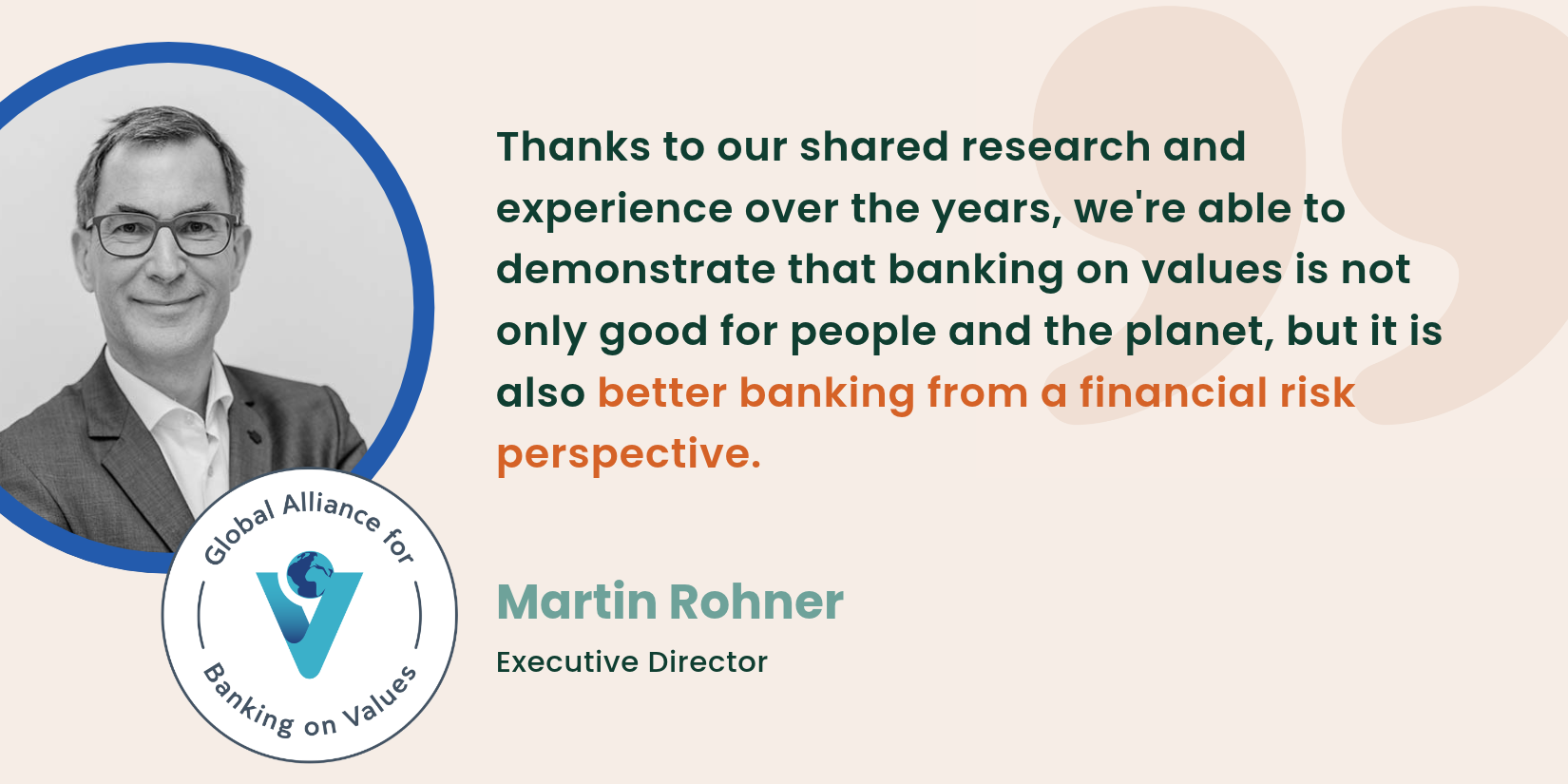
Thanks to our shared research and experience over the years, we’re able to demonstrate that banking on values is not only good for people and the planet, but it is also better banking from a financial risk perspective. We realized that together we could create more visibility around the concept of banking on values, and we could meaningfully engage regulators and policymakers.
We’re increasingly being approached by mainstream banks. We’ve developed tools and resources to support and advise these organizations so they can shift their business models in alignment with their values. It’s a long journey, but some of the larger banks are seeing the opportunity of being first movers in this space.
What’s the driver of that shift? Is it financial returns and sustainability, or consumer demand?
There are several drivers. For one, people are seeing that the current approach to “sustainable finance,” which is basically applying an ESG metric, is not changing anything. Yes, it gives more transparency and clarity, but it doesn’t have any impact. At the same time, banks are increasingly coming under pressure to create more legitimacy around their business models and seeing strategic opportunities on the horizon on the investing side. Consumer interest and brand reputation are also factors.
Climate change is a big one. We hear all the time from our members that climate change is impacting their clients. They have to think about both climate change mitigation strategies and, increasingly, climate adaptation strategies. We will soon publish a paper around climate adaptation and the role of the financial sector. Climate change, especially in emerging markets, is a reality. Agricultural yields are going down. Floods and forest fires are more frequent. Investors are starting to see that climate change poses tangible financial risks, and that the ESG framework doesn’t address them.
And consumer interest is being driven by a number of awareness campaigns, such as the Move Your Money campaign, the B Corp movement, and the community-development financial institution (CDFI) certification. And of course, this is also a focal point at the GABV.
Is investor interest growing in values-based banks because they outperform on the financial side, or because they are more resilient? What can investors do if they are interested in getting involved in values-based banking?
From an investor point of view, aligning your money with values-based banks is a solid financial decision. When you look at the mainstream financial sector over a long period of time, you see regular cycles of boom and bust. Values-based banks do not focus on short-term profit; instead, they aim for long-term financial resilience and stability. They want to serve their communities for years to come. Because of those priorities, we can demonstrate that values-based banks typically outperform global financial institutions in times of crisis.
Our members are doing very well. Because they’re growing, they’re always looking for growth capital. The GABV is currently developing a fund to support our emerging market members, so there are many diverse opportunities for investors to engage with our member banks. If investors are interested in supporting our member banks and the outcomes of their work across the globe, they are welcome to get in touch with me directly or to contact our members.
What about impact business leaders and consumers? Why should they consider moving to a values-based bank?
In terms of business leaders, my main message is that it makes a huge difference where you place your excess liquidity. For many of the world’s biggest companies, the emissions stemming from their cash and investments are larger than all their other emissions combined. Studies show that we would see a huge impact on climate change mitigation if some of the largest corporations simply moved their savings from mainstream banks to banks that avoid investing in fossil fuels.
From a consumer point of view, when you deposit your money into a values-based bank, overall you get the same service, more or less the same returns, and the benefit of knowing your money is helping do good in the world. It’s possible that you may earn a very slightly lower return in a values-based bank account, but in exchange, you get the non-financial return of knowing your money is helping to fuel the well-being of both your community and the planet. Many of our members offer the option to earmark your savings so your money can support the specific causes you care about, whether that’s women entrepreneurs, solar energy, or organic farming.
You can explore our member banks and find out if there’s a bank close to you. Some of our U.S. member banks offer excellent national service even if they do not have a branch near you. CDFIs also do wonderful work in their communities, so I encourage people to explore those institutions, as well.
Where do you see values-based banking headed in the next five to 10 years? What are the most important developments shaping the future of the movement?
When the GABV launched around 17 years ago, no one had heard of banking on values. Today, the concept has gained quite a bit of traction in the financial industry, although not yet as much as we’d like on the consumer side.
Over the next five to 10 years, our movement will continue to grow. One of the most important trends is the growing interest from mainstream banks. If some of these forward-looking banks position themselves as first movers, that could create an important tipping point.
Another development we see as essential to driving change lies with regulators. We’re increasingly seeing regulators integrate elements of the Principles of Values-based Banking into banking regulation. For example, in emerging markets, regulators are highly concerned with the role of the financial sector in supporting economic growth and creating income opportunities for people, so they are engaging with us around those goals.
What would the world look like if banking on values were the norm, and what needs to happen to get there?
If this kind of banking were the norm, I believe we would see a much more stable financial sector. We would see more equitable economic growth, and ultimately, we would also see more resilient societies and a healthier planet.
For that to happen, we would need to rethink capital markets as they are today. Today, the markets are driven by risk and return consensus with very little regard for the social and environmental impact of the underlying assets. In such a system, assets that maximize financial returns while externalizing social and environmental costs are rewarded.
We need to change that if we want finance that serves people and the planet. We would have to change the incentive system so that markets account for the true cost and benefits of what they finance.