Launched in Boston in 2016, Resonant Energy is on a mission to make clean, affordable solar power accessible to all, based on a commitment to principles such as community, equity, integrity, and excellence. Today, the Certified B Corporation™ and employee-owned company is one of the leading solar developers for nonprofit organizations in the Northeast, with around 60% of its projects located in environmental justice communities. Resonant’s clients range from affordable housing providers and senior living organizations to large-scale commercial buildings and new construction in Massachusetts, Connecticut, New York City, and Long Island.
Resonant brings innovation and creativity to make solar projects work for buildings and budgets that don’t fit the standard template, whether it’s helping a new building achieve LEED certification, retrofitting one of Boston’s many 100+-year-old buildings, or developing unique financing mechanisms for resource-strapped nonprofits.
Despite ongoing shifts in federal solar policy, Madeleine Barr, Resonant Co-founder and Chief Growth & Impact Officer, says powering organizations with clean, affordable energy has never been more important. “Electricity is expensive and the cost is not going down,” she says. “In Massachusetts, our fuel mix is heavily weighted toward natural gas, which is also spiking.” In a recent analysis, Resonant found that, while over the past 20 years, Massachusetts electricity rates rose by roughly 2.7% annually, over the last five, that pace has more than doubled—increasing by over 5% each year. “People are feeling it,” she says.
In this Q&A, Madeleine shares why she and the Resonant team of employee-owners are more committed than ever to finding creative ways to help community-focused organizations benefit from solar power—and why being a good neighbor is at the heart of the company’s strength and resilience.
Resonant emphasizes community-focused solar centered on principles such as partnerships, equity, and innovation. Why did you found the company around these principles?
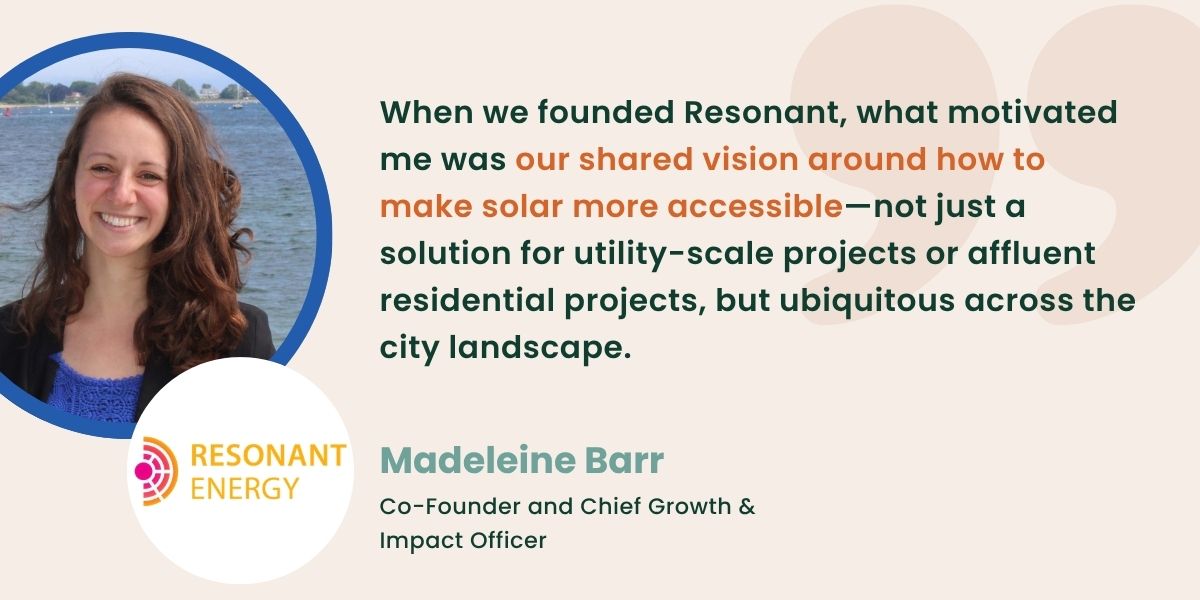
At Resonant, we see solar as more than an opportunity to build clean energy technology. Solar can be a tool to develop more resilient communities, build wealth in underinvested communities, and connect people around a future of clean, healthy neighborhoods.
A good representation of how these values play out in practice is a recent project we did with The Discovery Museum, a children’s museum in Acton, about 20 miles west of Boston. The museum was doing a campus redesign that included redoing its parking lot, ideally incorporating solar. They asked us to do an analysis, and we concluded that the new parking lot would have the capacity to produce twice as much power as the museum needed. So we worked closely with the museum CEO, board, and solar committee to put together a concept we refer to as a hyper-local community solar project. It’s a 327-kilowatt array that provides power to several local organizations and income-eligible households. Half of the power produced offsets all of the museum’s full annual electricity load. Another portion is sold at a significant discount to two nearby affordable housing organizations and a soup kitchen. And the final slice of energy is donated to 10 low-income area residents through a partnership with Green Energy Consumers Alliance and Boston Medical Center’s Clean Power Prescription Program.
It’s a great example of how one space can become this mechanism for clean power and connection among a variety of organizations. And to add on to the benefits, the museum now has an exhibit that teaches kids how solar panels work.
How do you engage with the community in the areas where your projects are installed?
These projects are being installed in dense urban areas, so they’re never a secret. People are always all around, and they’re generally supportive of solar projects. We want solar to be visible. We always try to do some kind of ribbon-cutting to engage the community once a project is complete. And when we work with schools or youth organizations, we always try to bring the young people into the process, whether through a site visit or celebration.
Sometimes our strongest role is not only about providing technical services, but as a connector between organizations in the community. One example is an early-stage project we’re working on in Roxbury. We were brought in just to provide feasibility assessments for a solar plus battery storage resilience project. Then, separately, we were approached by an organization a few blocks away that’s exploring how it could also become a clean energy community hub. We connected the two of them, and now they’re going in together on a grant application and inviting additional organizations to get involved.
Many of the organizations you work with are nonprofits or community organizations. How do you help these clients figure out creative ways to finance projects?
Financing is critical to make solar projects happen, so we work in many ways to help folks finance projects. For a long time, we’ve been able to provide no-cost financing through tools such as third-party leases—arrangements in which a third party agrees to pay all the upfront capital cost, and the nonprofit hosts the solar panels and repays the loan either through a lease payment or a discounted electricity rate. Many national financial institutions have been happy to offer that for large projects, and over the years, we’ve developed relationships with local solar financers willing to finance projects that are smaller, more expensive to build, or have a lower rate of return. However, with the loss of the solar tax credit and changes in federal policy for solar, third-party financing is now harder to do and much more limited. So we’ve shifted to helping nonprofits source mission-aligned loans and grants. Even without the tax credit, solar projects offer a fairly strong return on investment. With the right loan, these projects can have a positive cash flow for the entire duration of the term, and we have a network of partners who offer special interest rates for impact-oriented projects.
Impact financers are more important than ever with the loss of federal funding. We’re actively trying to engage impact financers around mission-aligned loans, funds, or collaborations that could help replace at least a portion of the former 30-50% tax credit, to help relieve some of that upfront funding and make these organizations’ goals within reach.
You’ve also developed a successful and innovative grant program. Can you share how you conceived of that and what it looks like?
Yes, we’ve worked quite robustly over the past few years to build out our grant program, and it’s been super successful in getting solar on the roofs of affordable housing and nonprofits. In just the past 12 months, we’ve helped nonprofits receive about $3 million in direct solar installation grants and $2.7 million in battery storage grants. Resonant and our partners have also received $450,000 in grants to fund our STAR for Affordable Housing and Solar Upgrading Nonprofits programs, which provide technical assistance, education, and small staff time grants to organizations to reduce the burden of exploring solar.
This isn’t something we’ve seen other organizations do. The genesis of the program came out of being in dialogue with and serving community organizations. Regardless of federal shifts, many of these organizations have barriers that make standard solar financing products unworkable, whether from an affordability standpoint or because they have complex legal or consent structures. We identified these distinctive needs through conversations with our partners, such as LISC Massachusetts and Providers Council, which is a network of human service provider organizations.
Another challenge we were trying to address with the program is limited resources. Community nonprofit organizations are typically resource-strapped, and they have a thousand things on their plates. They don’t have the organizational capacity to explore solar, even when it could provide them with a lot of benefits. So we started with a focus on education and outreach. Then, through organizations such as the Mass Clean Energy Center, we’ve been able to help these organizations access small grant stipends for technical assistance funding, which enables us to get the process started. If we discover we are able to structure a beneficial plan, we help them apply for more meaningful installation grants through organizations like the Department of Energy Resources (DOER), Department of Environmental Protection (DEP), or the City of Boston’s BERDO Equitable Emissions Investment Fund.
The grant programs are especially impactful because, in the end, the organizations own their solar array outright, so all of the long-term energy savings stay with the nonprofit. It’s also enabled us to explore additional blended financing options. For example, a nonprofit may be able to get a 30% tax credit in the form of elective pay, which is available for tax-exempt organizations, and then get another 50% of the project covered through a DOER grant, and then they could either fundraise or use reserve funding to cover the last 20% of the project cost.
Many of these initiatives require collaboration with local and state government programs. How does Resonant engage with those organizations?
Part of what has made our programs work, particularly for affordable housing or nonprofits, is our state-level policy advocacy. Our Co-CEO Ben Underwood is an elected member of the Interconnection Implementation Review Group, which is a utility industry working group to help simplify the process of interconnection, specifically for smaller mission-oriented projects. We’ve advocated for grant programs, such as the DOER’s Low-Income Services Solar Program. We’ve been able to do that effectively because we’re in conversation with nonprofit community groups, so we understand their needs and day-to-day challenges and can advocate for programs that will effectively address them.
Resonant is a certified B Corporation and an employee-owned company. How do those structures support your work? How do they affect your culture and your team?
I’m very proud of how our principles are woven into our DNA. It doesn’t ever have to be a choice between being a good neighbor and making money. We’ve set up our business model so our relationships with community organizations and our accountability to our customers are central to how we operate.
Our shared leadership structure, with four co-founders and an employee-ownership program, gives everyone a sense of ownership over the company. Our mission-driven work means our whole team is committed to driving positive outcomes for our customers. We’re doing good and important work in our communities. That doesn’t just make us a better neighbor; it makes us a better company. There’s a strong shared commitment to thinking expansively about how to balance financial sustainability with doing important, meaningful work, even as we face challenges.
I believe our culture of ownership and care is a huge reason we’ve been able to weather storms over the years, whether it’s today’s federal headwinds and loss of the tax credit, or COVID, or changing utility policies. Our team’s sense of accountability to our work has led us to be resilient and nimble, and to have a lot of ideas at the table when we hit challenges.