As the conversation around ESG continues to evolve, a bigger question is emerging: What does meaningful impact look like when a scorecard is no longer enough?
Jack Mardack co-founded Oyster, a global employment platform that achieved unicorn status and B Corp certification simultaneously — one of only 19 companies ever to do both. In his recent book Impact Unleashed: Building Companies That Scale Positive Change, Mardack explores why the tradeoff between commercial success and positive impact is not an economic law, but a design failure — and provides a practical manual for founders who are ready to build differently.
At the Consumer Impact Summit on Thursday, September 17, Mardack will offer a keynote Q&A conversation, moderated by Bark Media co-founder Jessica Kellner, bringing his unique perspective on the intersection of a company’s impact narrative and the evidence that supports it. In the related conversation below, Mardack takes a closer look at what he calls an “impasse” in the ESG debate — and why the end of ESG as a central framework doesn’t mean the end of impact. Instead, it provides businesses with an opportunity to move beyond standardized scorecards and be more specific about how they create positive change, who benefits, and what evidence demonstrates that the impact is real.
From the evolving role of certifications and consumer trust to the entrepreneurs and investors shaping what comes next, Mardack shares a forward-looking perspective on where impact business is headed — and what it will take for companies to earn the attention, loyalty, and capital of tomorrow’s savvy, discriminating consumers.
You’ve described this moment as an impasse in the ESG debate. What does that impasse actually look like from where you sit?
One side has stopped talking, and the other hasn’t figured out what to say back yet. Go back to the root question: what does it mean to be a good corporate actor? Our best answer to that, for a long time, was the ESG framework — environmental, social, governance. It gave us a scorecard, and to be fair, that scorecard did real work. The “E” in particular pushed operators to take their carbon footprint seriously, sometimes because they wanted to, often because regulators or vendors required it. But it was the same scorecard for every company — a software company and an ice cream company answering identical questions, which meant it could never really speak to what either company does in the world.
That sameness became the vulnerability. A well-funded campaign built around a simple message — get ESG out of my pension fund, because these considerations are a distraction from what a for-profit company is supposed to optimize — landed hard, and largely won. I don’t think there’s much uncertainty left about that. The ESG chapter, as a centralizing framework, is over. It doesn’t mean the underlying considerations — footprint, labor, governance — stop mattering. It means they step back from the center of the argument. Thank you for your service; the chapter’s closed.
That’s what makes this an impasse rather than just a defeat: the people who shouted “get ESG out of my pension fund” haven’t had anyone shout anything back yet. And there’s something real to shout back with. Consumer sentiment hasn’t gone anywhere — people are still ready to give their attention, loyalty, and dollars to companies genuinely trying to make things better. Capital hasn’t gone anywhere either; there’s real money looking for real impact. What’s stuck isn’t belief. It’s flow — capital and attention aren’t finding their way to the right destinations, partly because the methodology for identifying genuine impact is so fragmented. We’re mid-pivot, away from ESG’s borrowed scorecard and toward something built on each company’s own impact thesis: the specific mechanics by which this business creates change, and the evidence that confirms those mechanics are real.
So my answer to the impasse is direct: rise to the occasion and show the world your proof. Consumers are ready. Investors are ready, even if their methodology hasn’t caught up yet. The way through is for companies to offer their impact theses and evidence, and for the capital and customers who are already leaning in to meet them there.
What is causing this impasse / what about ESG makes it feel possibly outdated in the world of impact business today?
The outdatedness is really about incompleteness. ESG gave us a partial picture and let companies treat it as the whole picture — score high on one dimension, and it could paper over a low score somewhere else that actually mattered more. I’d describe ESG as internal impact: important, still worth doing, but never the full story of a company’s evidence, for good or for harm.
The clearest proof that this reckoning is already underway didn’t come from critics outside the movement but from within it. Dr. Bronner’s, the highest-scoring B Corp in the certification’s history, walked away from B Corp a couple of years ago, precisely because the old points system couldn’t distinguish real structural impact from accumulated scoring. B Lab’s response was to evolve the B Corp standards, and I’d characterize that evolution as exactly this shift — from ESG to impact, from an averaged scorecard to something that actually has to hold up as evidence.
 If we look at a world where “impact business” is the norm — what needs to change for that to happen? Who’s the driver? Businesses? Consumers?
Two different things have to happen, on two different timelines.
The first is new companies built for impact from the ground up — designed, from day one, so that the revenue-generating mechanism is the same as the impact-creating mechanism. That’s a design activity, and I hope Oyster is a useful example of what it looks like. I think we’re going to see an increasingly exciting generation of founders drawn specifically to what I’ve described as the fourth ring of entrepreneurship. The first three rings are familiar: give yourself a job, give jobs to other people, create value for customers. Most founders and most of the capital that funds them — stop there, and ring three is hard enough on its own. But I think more entrepreneurs are going to be called specifically to that fourth ring: having a measurable, structural impact on the world, not as an add-on but as the design brief itself.
The second, more diffuse shift is existing companies — the incredibly broad and varied territory of businesses that already want to bring their operations into greater alignment with the good they claim to care about. For them, what needs to change is more immediate: start reporting. Start identifying the specific mechanisms by which you’re improving the environment or benefiting a specific stakeholder, and build the evidence base to prove it.
Consumers, for their part, are ready — more ready than the market has given them credit for. Their preference for purpose-driven companies is real but held in a kind of latency, suppressed by cynicism and uncertainty. Give them real evidence, and I think latent preference accelerates quickly. But there’s real work still to do here too, and some of it belongs to certifications like B Corp: continuing to evolve their standards in the right direction, and doing more to help consumers understand what the label actually signals. A lot of people still don’t know what a B Corp is or what it means — that’s a gap worth closing now, while the definition itself is being sharpened around impact and evidence.
Where do certifications come into the picture about trust? If a consumer label is doing its job, does it act as a proxy for trusting the company — or is it the company that does that work?
Both — genuinely both, not as a hedge but because it’s not actually one job. It’s not an abstract scorecard doing the trust-building. It’s the real evidence and the specific, ongoing storytelling that come from actually operating this way.
At Oyster, every impact report surfaced something we hadn’t set out to find. We built the company to change the lives of remote workers, especially in parts of the developing world that had historically been shut out of such work. What we also learned, because we kept looking, kept probing our own stakeholders, is that we were changing the lives of women globally in ways we hadn’t specifically designed for — not entirely surprising in hindsight, but not something we’d have discovered if evidence-gathering had been a once-a-year formality instead of an ongoing discipline. That kind of discovery is what a company owes to its own impact thesis. A certification can vouch for the floor. Only the company, through that continuous work, can tell you what’s actually happening above it.
Let’s put you in the role of a futurist for a moment: What does the impact business landscape look like 10 years from now? And how has that landscape influenced the broader consumer landscape and expectations beyond impact brands?
Two things, both already in motion.
First, I expect a genuinely new ecosystem of founders and funders oriented specifically around that fourth ring — ambitious, systems-level impact tackling enormous addressable markets, not as a constraint on commercial ambition but as part of it. Right now, the methodological excellence needed to fund and build these companies well is clustered in a small number of places — a handful of funds, a handful of firms that have actually figured out how to evaluate an impact thesis rigorously. Ten years out, I expect that expertise to be far more distributed, not concentrated in the same few names.
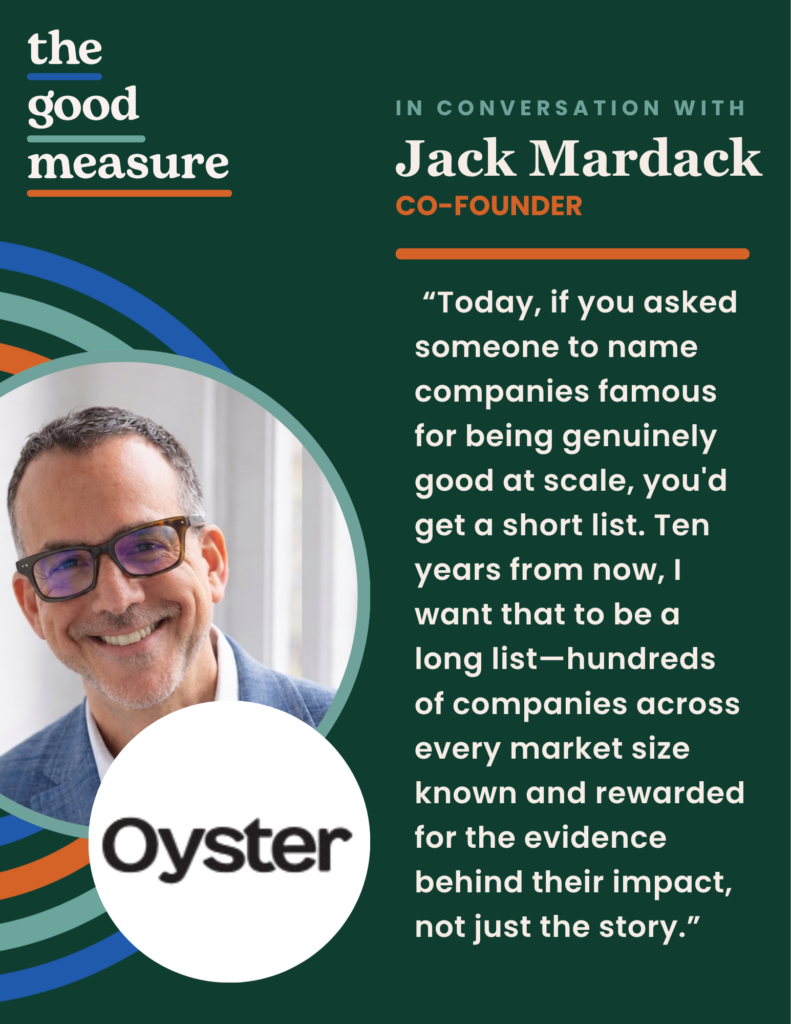
Second, and this is the part I actually hope for most: today, if you asked someone to name companies famous for being genuinely good at scale, you’d get a short list — maybe a handful of names, repeated often. Ten years from now, I want that to be a long list. Hundreds of companies across every market size are known and rewarded specifically for the evidence behind their impact, not just the story. If that happens, the ripple effect goes well past companies that call themselves “impact brands.” Consumers who’ve learned to ask “where’s your proof” of one company’s category don’t stop asking that question at the category line. It becomes how they evaluate claims generally — quality, sourcing, safety, all of it. That’s the bigger legacy this moment is actually building toward.
Jack Mardack co-founded Oyster, the global employment platform, and served as its Chief Impact Officer after leading marketing as CMO — a vantage point that runs through everything above: the overlap between building the narrative and building the evidence behind it. He is the author of Impact Unleashed: Building Companies That Scale Positive Change.
See Jack’s Keynote Address at the Consumer Impact Summit, September 15-17 in Bentonville, Arkansas.