Sarah Sikich lives across the street from the first Giving Grove orchard in Kansas City. In 2009, the year she and her family moved in, the school district decided to close the public school across the street, the only public school in the neighborhood. Soon after, a group of parents began advocating to reopen the school. The district’s response? If the community could prove it would show up to support the school, the district would consider it.
Around the same time, The Giving Grove, a Kansas City-based nonprofit, was developing the idea of planting food orchards in Kansas City neighborhoods with high rates of food insecurity as a grassroots effort to provide free, fresh fruit to the community. The parents in Sarah’s neighborhood connected with the nascent organization, and they decided to partner to plant an orchard next to the closed school.
Almost overnight, neighbors began treating the space like a park, gathering to walk dogs, ride bikes, and play on the playground. The district took notice of how the community had rallied around the project and decided to reopen the school.
Today, that school is the No. 1-ranked public school in the district. People who once left for the suburbs now stay, and home values in the neighborhood have doubled. The school is being remodeled to keep pace with its growth, and when construction began, the neighborhood had one non-negotiable request: Leave the orchard untouched.
“It has become this wonderful gathering space for our community,” Sarah says, now The Giving Grove’s Director of Marketing and Communications. “And I see this same story play out in neighborhood after neighborhood, city after city.”
The Giving Grove is a capacity-building nonprofit, led by co-executive directors Ashley Vernon and Erica Kratofil, that supports more than 847 orchards and approximately 1,700 trained volunteer stewards in cities including Kansas City, Atlanta, Dallas, Denver, Omaha, Memphis, Pittsburgh, and Seattle. Its mission is to strengthen communities and improve the urban environment through a nationwide network of sustainable small orchards — and it does so on an invitation-only model, waiting for communities to come to it rather than pitching the idea itself. That approach ensures community buy-in from the start, Sarah says, setting projects up for success.
In this Q&A, Sarah shares how The Giving Grove builds community connections, the corporate partnerships that are key to their success, and why this network of small orchards is part of the climate solution.
Can you share a bit more about how The Giving Grove got started and how its network model works?
Over the last couple of decades, the idea of free food forests has gained momentum in cities across the country. As that was happening, The Giving Grove was the only organization collecting best practices for community orcharding. Before that, most information was either about commercial orcharding or how to grow an apple tree in your backyard. Over time, The Giving Grove developed a network of experts in this emerging field, and now we have this incredible knowledge base, we’re able to spread from city to city. We think of how we operate like the trunk of a tree, branching out.
Each Giving Grove project is unique because every nonprofit comes at it from a slightly different angle. Some of our nonprofit partners are community gardening organizations, while others are food banks or tree nurseries. Every city also does things differently. For instance, in Denver, they prefer food forests, which are these multi-level horticultural gardens. In Kansas City, they like more of the traditional orchard approach. They’re clean, linear, and traditional looking. In St. Louis, all of the orchards are part of community gardens.
Once a program is up and running, we help the program leaders tap into our network and make beneficial partnerships with other local and national organizations. That network is a powerful tool. It connects all of us, so, for example, we can seek larger grants we wouldn’t be eligible for as single organizations, and the groups are able to connect the dots and help each other. For instance, in a recent meeting, our Dallas affiliate group mentioned they needed a truck to move plant material. Another of our network members found out Kubota was offering a grant for a truck and sent the info their way.
I think our model is pretty innovative, and I don’t see many other nonprofits leading through collaborative networking like we are. Considering the funding challenges nonprofits face, I believe the nonprofit community partnering and networking together like this is the way of the future.
Community and networking are key to your model, from the structure of the organization to its funding model. How does that community element play out in the orchards themselves?
People like the idea of taking food access into their own hands. Community gardens are amazing, but they’re set up where each person is assigned a plot and grows food for themselves. An orchard’s different because it’s a common space, so the food is tended by everyone, and it’s intended for everyone. That model creates an opportunity to spread the impact outside your own household.
As an orchard steward myself, I always say this: You may plant an orchard for the apples, but you maintain it for the community. The humans who choose to grow food for others are the best humans in the world. Creating this community of people in your neighborhood becomes a powerful tool to bring people together. Many communities have multiple languages spoken and different cultural norms, but everyone understands the language of fruit.
Our orchard stewards aren’t horticulturalists. They may have experience gardening or grown up with a peach tree in the yard, but this is not what they do for work. They’re teachers or business owners or marketing professionals. The program managers train the orchard stewards throughout the life of the orchard, and that training goes beyond how to maintain apple trees to how to make connections to support the space.
This model means a beautiful community inevitably grows up alongside the orchard. The truth is that free apples and pears aren’t going to solve food insecurity. They help put a dent in it, and they provide healthy calories and access to fresh food, but so much of the value of these spaces is about being outside, spending time in nature. Our orchards are typically planted in neighborhoods that are mostly concrete. The neighbors are tired of that. They want grass, dirt, and trees. These spaces create so many physical and mental health benefits. That becomes the driving factor. The best part is the opportunity to harvest and share the food we’ve all worked together to grow. Free fruit is just the icing on the cake.
Your funding model also relies on a network of partners. Can you share how that works?
The largest portion of our funding comes from corporate and business partners, so that community is integral to our work. They typically provide unrestricted funding, which means we can direct the resources wherever they’re needed most, whether it’s establishing a program in a new city or planting orchards in communities that want to expand. To give one example, Tito’s Handmade Vodka has been a generous supporter. They’ve funded big planting projects in several cities, and now they’re contributing a large portion of the matching funding needed to launch a program in Memphis. We’re also a 1% for the Planet environmental partner, which has been really beneficial to our organization.
Our corporate sponsors also support us beyond funding. A few years ago, we were doing a rebrand, and we asked one of our corporate partners for advice. They brought in their marketing department to lend support on strategic planning for the project. And our businesses also provide an amazing volunteer force. They love to schedule days to come out and help in the community. They’re great workers, it’s a lot of fun, and it helps grow the system of support in the city.
What benefits do the corporate partners get out of their partnership with The Giving Grove?
When we ask our corporate partners why they partner with us, they almost always say the same three things:
- First, we are in so many locations across the country. That makes us a good fit for national organizations with multiple offices or for organizations trying to grow connections and community in specific cities.
- Second, we value strong data. It can be hard to measure impact, and a lot of corporate social responsibility officers we work with need hard numbers about the impact of their work. We not only measure production data, like trees planted and servings of fruit generated, but we also collect environmental data, such as how much carbon is sequestered and stormwater retained. We combine that with census data to calculate the number of people impacted by their giving. For some partners, we create individualized annual impact reports that also include stories with photos and quotes they can use in their own impact reports.
- And finally, using volunteerism as team-building is an important tool for many of our business partners. It’s one thing to give dollars, but putting sweat equity into the community is really meaningful for employees. With 847 orchards, we can find a volunteer opportunity for anyone.
The Giving Grove also describes these small orchards as “part of the climate solution.” What impact do these spaces have on climate change and relevant community health outcomes?
Like all trees, the trees in these orchards provide shade and help clean the air. In urban areas with lots of industry, air pollutants lead to negative health consequences, so having these natural air filters is beneficial for the neighbors. Giving Grove program managers also design and maintain the orchards using holistic methods. We want to ensure it’s safe for anyone to pick a piece of fruit right off the tree and not be worried about chemicals, and the probiotics and supplements we use on the trees also help nourish the soil. And then fruit trees have all these beautiful blooms, so these spaces support tons of pollinators. When you walk by in the springtime, they are just completely buzzing with life.
Our orchards’ carbon sequestration data is also impressive. A single orchard with an average of 15 trees has the ability to sequester approximately 23 tons of carbon over 25 years. Nationally, our annual carbon sequestration is equivalent to over 24,000 round-trip flights between New York and LA.
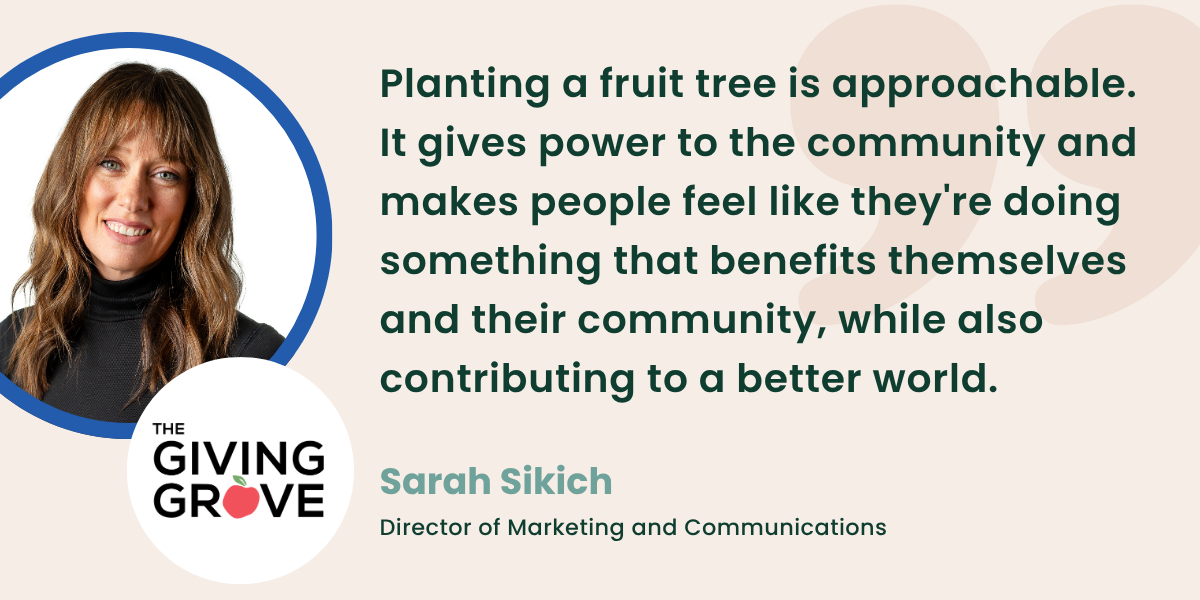
Lastly, I believe being part of these orchards also helps people overcome anxiety and powerlessness in the face of climate change. Climate change feels so insurmountable. How do we even wrap our minds around how to stop this train we’re on? Planting a fruit tree is approachable. It gives power to the community and makes people feel like they’re doing something that benefits themselves and their community, while also contributing to a better world.
What’s on the horizon for The Giving Grove?
We recently hit a big milestone of having reached a million people within walking distance of an orchard, so that is very exciting. But we don’t believe in growth for growth’s sake. We are in 17 cities now. In five years, we plan to be in 25. We want to grow sustainably so we can continue to invest in our existing programs and cities as we expand. We want to ensure every city is as strong on day 1,000 as it was on day 1. As our programs become more mature, their needs also become more mature. Seven years ago, a lot of our classes were about digging a hole correctly. Now we’re talking about sustainable revenue sources.
Yet we do want to be able to provide our resources to more people across the nation, so we’re exploring digital ways to expand. We’re currently developing an online learning platform, and we’re workshopping an idea for an “orchard in a box” program. While those programs wouldn’t offer the hands-on training element of the program, they can provide the nuts and bolts needed to launch. We’re also building a closed-loop database to store our extensive knowledge and resource base, so program managers can find and share information more easily and develop custom plans for each situation, pulling from our wealth of practical knowledge.
When it comes down to it, The Giving Grove wants to continue to connect our friends, neighbors, and community members with the food they eat, the Earth they cherish, and the community that surrounds them. When you are connected to those three things, you have the power to enact real impact in the places it matters most. We believe that community-led orchards are a perfect way to do this, and we hope to continue providing these tools by growing our network of partners in more cities and in more neighborhoods for decades to come.