Founded in Burlington, Vermont, in 1981, Rhino Foods is a certified B Corporation that develops and manufactures bakery-style ingredients for ice cream and frozen desserts. Its founder, Ted Castle, has spent decades looking for ways to “impact the manner in which business is done.” In 2007, that mindset led Rhino to pilot something unusual: a small-dollar loan program run in partnership with a local credit union, designed to give employees a safe, affordable alternative t to predatory lending when unexpected expenses hit.
That pilot became the Income Advance Program, now offered by more than 300 businesses across Vermont and beyond. In 2018, Rhino Foods launched the nonprofit Rhino Foods Foundation to help other employers adopt the model, demonstrating that financial stability for workers and a healthy bottom line for businesses aren’t competing goals — they go hand in hand.
Executive Director Christina Blunt leads that work today. Before joining the Foundation in 2022, Christina spent years in social impact and capacity-building roles, including as a researcher and consultant based in the Middle East and West Africa, a program manager for Feeding America in Miami, and a senior program manager at the Harvard School of Public Health. “Unexpected financial burdens happen to all of us. But knowing a financial emergency is inevitable and actually having the money at that moment are two different things,” she says, a reality at the center of how she talks about the program.
In this Q&A, Christina shares the origin story of the Income Advance Program, why she believes employee financial wellness is good business, and what she’s learned about trust, mutual support, and community from watching the program work.
Can you share a bit about the context and environmental factors that led Rhino to develop the Income Advance Program?
The larger context at the time of the program’s founding was that regulatory changes in the financial services industry had left this huge hole in terms of access to affordable credit for your average low- to middle-income worker. That’s how the payday lending industry really started to blossom in the ’90s. By the mid- to late 2000s, there were a lot of conversations, especially in the credit union community, about the problem of this predatory industry. States started regulating it, but people still didn’t have an alternative. This became part of the conversation around what a good lending solution could look like.
Fast forward to the 2020s, and employers are exploring ways to bolster their employees’ financial well-being, for example, on-demand pay or childcare support, yet there is still something about providing loans that can feel like a leap. Rhino Foods Foundation works with employers to understand that this program is just another tool in that same belt, providing a safe, regulated avenue for people to be able to address expenses that are, as I like to say, out of budget.
The thing I find most interesting about the program’s origin story is the cross-sector collaboration between financial services organizations, employers, and nonprofit community organizations. Each of those stakeholder groups saw how they could play a role in offering a practical program that responded to people’s needs.
Why is supporting employees’ financial well-being beneficial for business owners? Why does this make sense as a role for business owners to play?
I know this may seem obvious, but the No. 1 reason people go to work is to get paid. People can sometimes lose sight of that, especially in mission-driven organizations. I love my work and the impact it has, but I’m here first and foremost to be able to pay my mortgage, put food on the table, and buy new clothes every time my children outgrow theirs, which is more frequent than I would like.
At the most basic level, financial security is why people come to work. Of course, pay is the foundation of that security, and we expect businesses to pay fair wages. But there are limits to how much employers can do in terms of pumping up paychecks. So many things make the cost of living challenging, and not all of it has to do with pay or hourly wage. There are public policy failings linked to our housing crisis, childcare crisis, healthcare crisis — and we’re asking employers to bear more and more of that burden as the cost of all of these things go up each year.
Something like 67% of Americans report that they are living paycheck to paycheck. I don’t love to quote that statistic, because “living paycheck to paycheck” means very different things to different people. You may be living paycheck to paycheck because you are underpaid, and that is certainly an issue in this country. But you might also be living paycheck to paycheck because you are at a point in life where you’re paying a ton for childcare, and you’re also doing your best to save for retirement, and you’re also trying to pay off student loans and vehicle loans.
Most people aren’t struggling with a lack of knowledge of how to budget. Unexpected financial burdens happen to all of us. But knowing a financial emergency is inevitable and actually having the money at that moment are two different things. Even for folks who have been able to build savings, it’s often in an account type you don’t necessarily want to access when something unexpected happens. Your options then are usually not ideal. You can rely on credit cards with interest rates that are through the roof, or you can take a hardship withdrawal from your 401k if that’s available to you. We’re offering a tool to take care of a problem and not have it open the door to additional debt or losses down the line.
Why is an income advance loan a more beneficial option for folks in need of short-term financial support?
These loans are a practical tool that gives employees access to a relationship with a local financial institution that’s built on trust. Once it’s set up, unless the employee opts out, the deductions continue into a savings account, so it also offers an opportunity to build a foundation of financial well-being.
It provides an important pathway to people who may not have a credit history for a variety of reasons, such as young people just entering the workforce or recent immigrants. Having a credit history is critical to access the whole financial system and to be able to live in a new place.
You feature an ROI calculator for businesses on the website. Why and how did you put that together?
Having seen all of the upsides of this program, I got sort of flummoxed by businesses asking about the cost calculation. It’s almost comical if you put in the numbers. At Rhino, it’s something like 7,000% ROI in the most conservative scenario. It basically doesn’t cost employers anything to implement this, maybe $1,000 to set it up. That is incredibly cost-effective for an employee benefit that will be accessed by between 12% and 20% of your workforce in a given year and has so much upside in terms of retention.
Most companies don’t have a line item for turnover or employee retention, but these costs add up. We want to help employers see those hidden costs and understand how impactful simple levers around improving retention can be on their bottom line.
What benefits have you seen this program offer beyond improving retention?
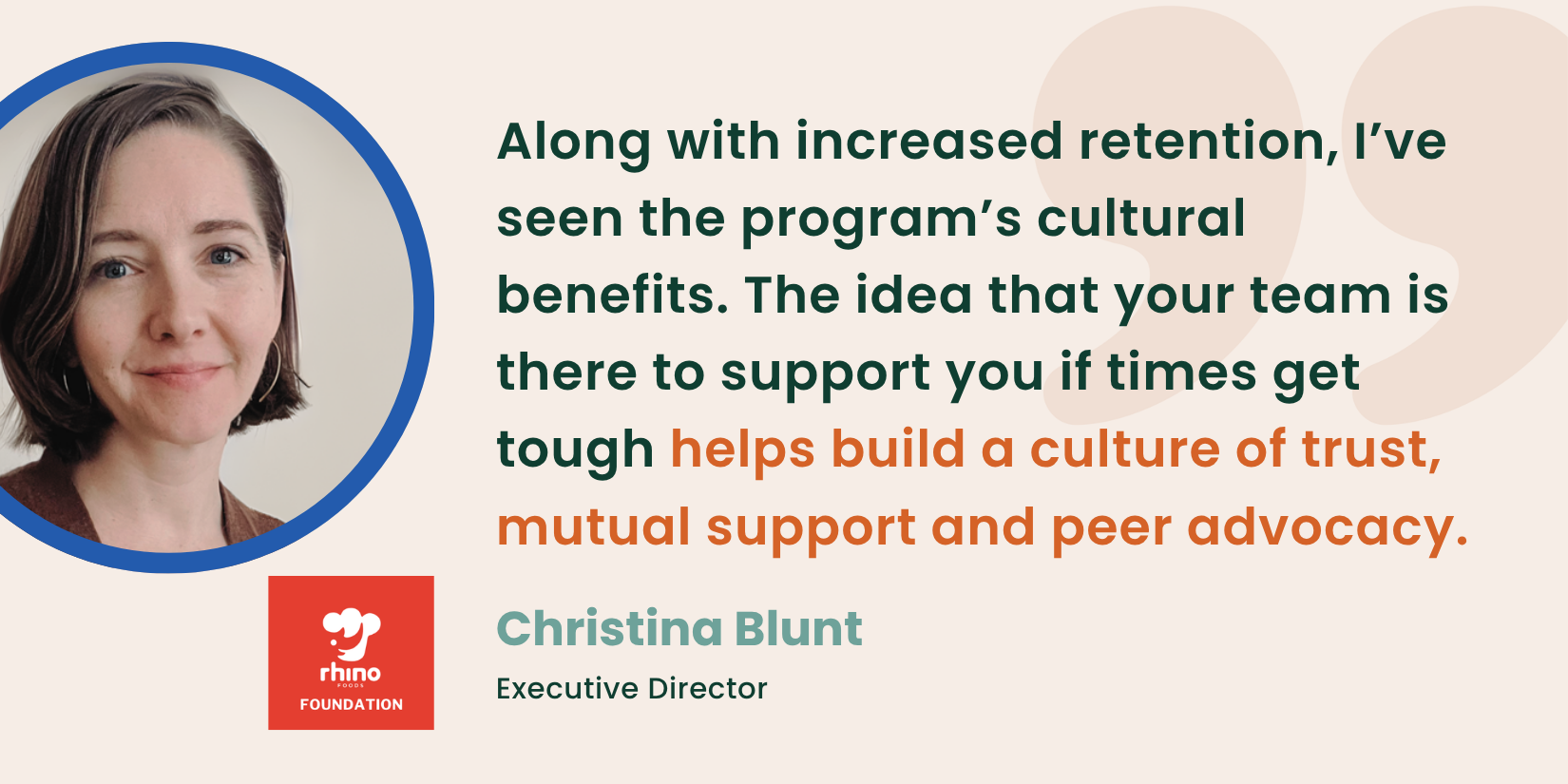
I have the gift of proximity to the Rhino team, so I get to witness firsthand this program’s impact in the workplace. Along with increased retention, I’ve seen the program’s cultural benefits. The idea that your team is there to support you if times get tough helps build a culture of trust, mutual support, and peer advocacy. There’s a strong sense of loyalty that comes from it. It also helps alleviate financial stress, knowing that if something unexpected comes up, I’m going to be able to handle it. Many studies have shown the negative impacts of financial stress on productivity, happiness, workplace safety, and distraction.
People can use the loan program for something as simple as Christmas gifts. It’s nice to know you have an easy, low-interest way to finance gifts for your kids or family and pay it back incrementally over the next few months. So yes, it’s alleviating financial stress, but it’s also alleviating parenting stress, life stress, and just helping people know they have an extra resource so they can show up in the best way possible for the people they care about.
The Income Advance Program grew from a single company into a foundation created to roll it out across many businesses and communities. Do you see that kind of community impact as part of the work of the business community?
I don’t think we can overestimate the value of community and the increasing value of showing up for one another and not losing sight of our humanity. Twenty years ago, we only thought about corporate social responsibility in terms of financial donations, which is absolutely still important. But today, employers are thinking more about the levers they can pull to remove barriers in the lives of their workforce.
It can make a huge impact when business leaders think outside the box and consider that, just because this is the way we’ve always done something, it doesn’t mean we have to do it that way. Innovation happens when leaders pause and consider how their business decisions impact the lives of the people inside their company and the lives of people outside the company. Even if a decision is good for the bottom line, is that the only metric? That’s something the B Corp movement talks a lot about.
Business leaders hold a huge amount of social capital, so business leaders being champions who want to work to find solutions for people can influence the economic stability of whole communities. Of course, business leaders can’t and shouldn’t try to fix every systemic issue people face. But I do think the conversations business leaders have within the policy and the political space carry a different kind of weight, and business leaders play a critical role as examples and advocates.
Can you share a favorite moment from your work at Rhino Foods Foundation?
A while back, we had a day of training and education at Rhino during a less-busy season. During it, I did eight 45-minute presentations over the course of two days, rotating through groups of people to tell them about the Income Advance Program. In one of the groups, there were quite a few recent immigrant employees from various countries in West and Central Africa. They were mostly Francophone, so they had an interpreter.
As I was explaining the program, the interpreter was explaining it to them, and it turned into a group conversation that I was slowing down. The more experienced employees in the room were talking to one another about how to access the program, why it was important to build your credit score, how it worked, and what it was going to do for you. I just sat back and watched it happen. It made me realize how, when you create an environment where people feel safe to do so, they show up for one another. Seeing people give each other that level of mutual support, to navigate financial challenges and understand the system they’d moved into, was really special. As an employer, if you can create a space where that feels possible and give people tools to make it more likely that they’ll succeed — that’s really powerful.
Any last thoughts you’d like to share?
I want to express how pervasive the need is for this kind of financial tool. We live in an intentionally architected financial system designed to benefit certain people and punish others. It’s no accident that people find themselves in financially precarious situations. The whole narrative we’ve constructed around it is based on personal responsibility: If only you knew more, or if only you were better at managing your money, then you would be able to somehow get blood from a stone.
That’s the thing I keep coming back to in this work. How do we continue to reiterate that, if you’re not in this situation, it’s not because you are superior to somebody who is? It’s just that you have a better set of circumstances — the cards were dealt in your favor, or you were in the right place at the right time. We all hit bumps in the road sometimes. The difference is that, for people living on the margin, a bump can be cataclysmic, whereas for somebody in a different situation, it’s something you can laugh about later with friends.
Rhino Foods Foundation spreads innovative workplace practices that champion employee financial stability and make good business sense. Contact Rhino Foods Foundation to learn more about implementing a new workplace practice or how you can partner with or support their work.