Justice Climate Fund is a national nonprofit driving transformative investments that strengthen under-resourced communities across the U.S. JCF seeks to catalyze large-scale change, leveraging the power of capital, partnerships, and scalable solutions to build an equitable climate and clean energy future.
To achieve its goals, JCF partners with a network of community lenders and a broad ecosystem of investors, nonprofits, philanthropies, developers, and other stakeholders to mobilize capital and resources to fund projects that provide clean energy, support cleaner air and water, improve public health, and build economic and environmental resilience so all people can thrive.
“Our primary approach since the beginning has been based on a recognition that local lenders who already have community trust and relationships—such as CDFIs, green banks, and minority depository institutions—are the best ones to solve for that gap in energy,” says CEO Amir Kirkwood.
Amir leads JCF’s mission to drive equitable climate and clean energy investments through innovative financing solutions. In this Q&A, he shares why expanding access to capital for clean energy projects is a critical lever for enhancing community health and resilience, and how JCF approaches its work to drive these transformative outcomes.
Why does JCF view clean energy projects as a critical component of building health and resilience in under-resourced communities?
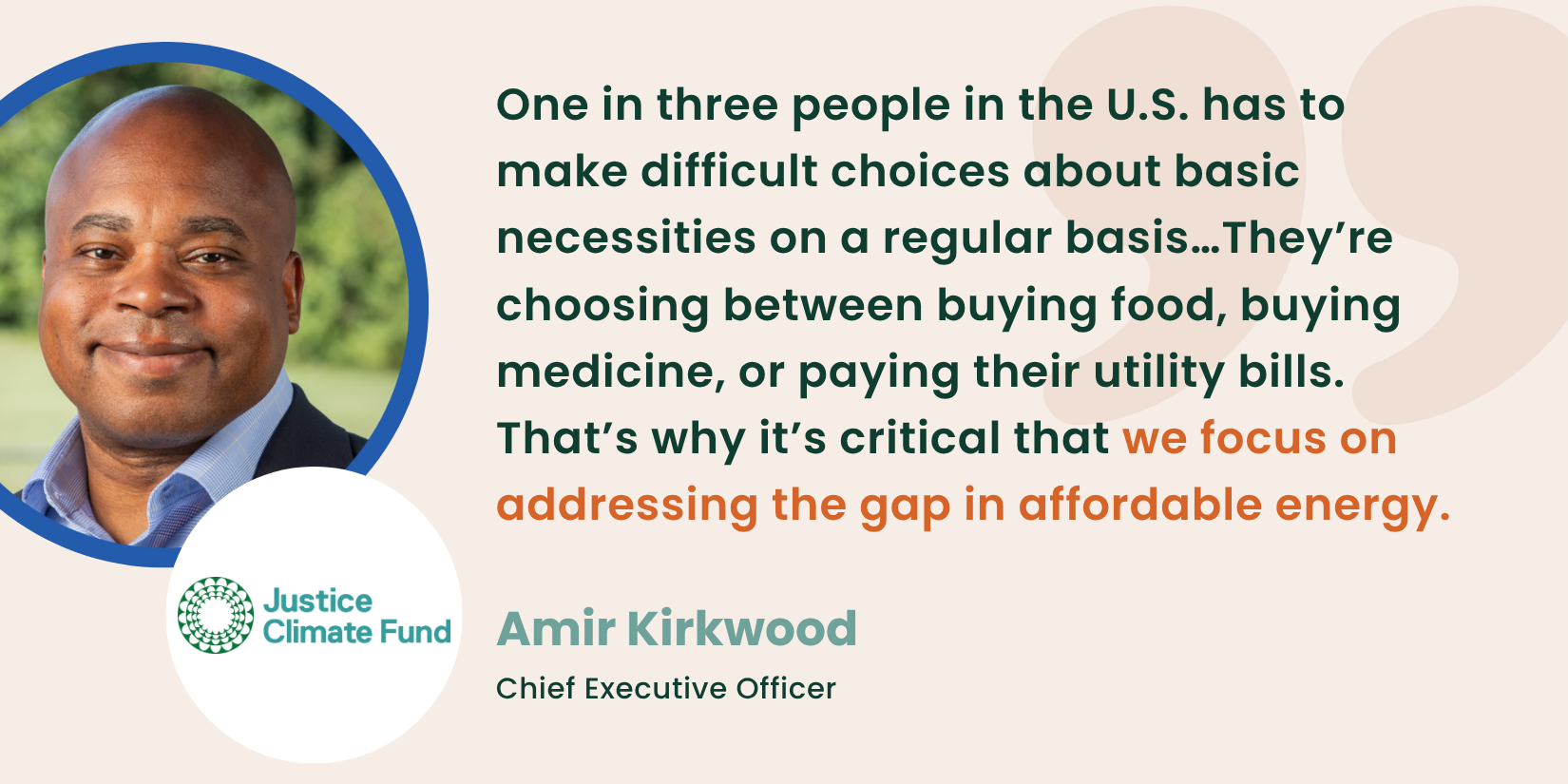
Over 100 million Americans live in under-resourced communities. One in three people in the U.S. has to make difficult choices about basic necessities on a regular basis—energy and utilities among them. They’re choosing between buying food, buying medicine, or paying their utility bills. That’s why it’s critical that we focus on addressing the gap in affordable energy. Clean energy is an effective way to meet that need.
Our job at JCF is to help folks understand how practical it is to bring energy efficiency, energy savings, and resiliency to communities. These issues often come up at the community level during and after severe climate events such as Hurricane Katrina or Hurricane Helene. But energy inefficiency and high energy bills affect people every day. For example, when a new data center or business park comes into a community, it may be beneficial for jobs and the economy, but it can also affect the grid and increase energy costs. Where does that impact land? With working-class families who might see their energy bills spike by 20% or 30% in a very short period of time.
How does expanding access to capital for clean energy projects help address these problems and affect the people in these communities?
First, it affects people from a pocketbook perspective. We want to add energy affordability into the discussion around affordable housing. Clean energy has been proven to reduce utility bills and create local jobs. We take a place-based approach and consider the end users of every project. For example, many under-resourced communities have a high proportion of renters, so we work to ensure we’re creating affordable, multifamily housing that delivers the benefits of clean energy to renters, as well as property owners. We also support community business owners. Many businesses own real estate and can benefit from solutions that lower their energy bills. Think about your favorite community diner that’s been around for years. They likely own their property and operate on slim margins. Yet many small business owners have not considered how energy efficiency improvements could help them reduce costs, enabling them to earn more, hire more people, and continue serving their community.
It’s also important from a health perspective. Every community deserves clean air and water. It’s that simple. Emissions and pollutants have a measurable impact on people’s respiratory and cardiovascular health. When you finance building retrofits that lower the cost of energy and emissions, those benefits flow toward better health care, both by creating healthier physical spaces for people to live and work and by lowering energy bills so people aren’t having to trade the cost of energy with the cost of health care.
And last, it increases community resilience to extreme climate events. It’s a fact that we are dealing with more of these, so fortifying buildings against them is a critical community benefit. Communities are increasingly forming resiliency hubs, where a community anchor such as a church, YMCA, or government building serves as a hub for distributed energy and a place of shelter during climate events. If and when the power grid goes down, it’s important that these buildings have a backup power source.
Why does JCF’s strategy focus on empowering a network of community lenders, and how do you approach that work?
Community lending is the best-kept secret in America. Most people visualize banking and finance as these gigantic institutions. We do have those large institutions, and they are critical for driving large-scale investment worldwide, including in clean energy. But at the community level, lenders are supporting people with things like first homes and local businesses. Trust is necessary because these are typically people’s largest and most important assets. Community lending brings trusted partnership to help people make the financial decisions that enable their assets to grow and thrive. They’re partners on the front end and throughout the lifetime of that loan or investment. As circumstances change and with life’s ups and downs, you want a partner who’s invested in supporting you long-term.
Since its founding, JCF’s work with our network of community lenders has focused on three principles: invest, empower, and amplify. The investment part is the most obvious. Community lenders are already deep investors in initiatives ranging from affordable housing to small business lending and nonprofit institutional finance. We want to increase their ability to do more of that work, adding in clean energy and resiliency lending.
Empowerment is the next piece. We work with our community lenders to help them build connections that strengthen capacity, enabling them to be more effective lenders and drive deeper impact. Getting these projects off the ground is not just about capital. It’s often a question of access to information, technical assistance, and support with deal execution—all critical to making financing happen, beyond the money. So, we provide resource hubs designed to bring community lenders the resources and knowledge they need.
Finally, there’s amplification. We want to share our learnings and stories. We want to make sure everybody, from the local community to national actors, understands that this type of investment and partnership has a deep, lasting impact. Stories from a community lender in one state can influence decisions by another community lender in another state.
Are most of your community lenders already working in clean energy? Do you bring that to them as a new opportunity or an expansion of what they’re already doing?
Many community lenders have been investing in clean energy products for a while. To do more of it, they need access to capital that enables them to take on longer-term risk or deeper risk. In other cases, this area of investment is new to them. They’re responding to what they hear from customers—“Why don’t we do PACE financing here?” or “What would it look like for me to install solar panels on the roof of my building?” They want to lead that activity in their communities.
Our response to both of them is absolutely, yes, we want to help you do more. JCF supports them in three key ways: one, we provide credit enhancements to help those lenders take on more risk; two, we help them syndicate risk by bringing in additional lenders or investors to jointly finance large projects; and three, we sometimes act as a direct lender.
How have you seen cuts to federal funding affecting community lenders and your work in this space?
Federal funding, particularly the type that has offered opportunities over the last few years, has been transformative. But what made it transformative was its role as the glue that could bring shovel-ready transactions to market, giving organizations growing in this space the flexibility to access the technical assistance and other support they need to become clean energy lenders.
Federal funding was never the whole story. These projects have always required flexible capital from multiple sources to bring transactions to market, regardless of what’s happening at the federal level. So, we are now spending our time working on enhancing the local relationships and partnerships that are driving solutions. We’ve always known blended capital was necessary. Right now, it’s just about shifting the model to fill the gaps left by federal funding with private capital.
Is there an example of a current project in this area?
One project is with Hive Fund for Climate and Gender Justice, focused on advancing climate and clean energy projects in under-resourced communities across the South. Hive Fund supports groups working to accelerate the clean energy transition in ways that center justice, redistribute power, and create healthier, safer, and more prosperous communities.
We received a grant from Hive Fund to help unlock shovel-ready projects that have been delayed or stalled due to federal rollbacks. Our pipeline of projects in the South includes community solar installations at local schools and hospitals; solar-powered resilience hubs that provide reliable power during outages; energy-efficient upgrades that lower utility costs; and solar energy systems that help safeguard access to clean drinking water in extreme weather in communities across the region.
We are spending the rest of this year building what we believe will end up being a $10 million investment to support existing CDFIs and green banks on the ground to execute an estimated $65 million in projects they’ve been working on that already have credibility, trust, and planning at the community level. We’re solving for a gap in financing by working with partners on the ground. We’re really excited about the work and looking forward to seeing the outcomes over the coming years.
In the big picture, what will help drive more investment dollars toward clean energy?
Two things: Performance data on impact and great storytelling. Going back to our framework of invest, empower, amplify, we really want to focus on the empowerment and amplification pieces. Measuring impact and telling stories are the keys to showing the benefits of this type of investment and scaling the field.
Performance data is critical. We want to learn as much as we can. What worked well, what didn’t, what should we be doing more of? Last year, we partnered with the Sorenson Impact Institute to develop an impact management and measurement framework that will guide how we assess, measure, and communicate our impact. We need data to demonstrate that the level of concern about risk is not met by the reality on the ground. And then we need to tell our success stories. We want to share, for example, the amazing real-world outcomes of just one $5 million investment over time.
That’s where we have to dig in. There’s no dearth of capital. We need the data and proof points to motivate people to direct capital into this space. The environment will always be changing—sometimes we have strong policy support, sometimes we don’t. But knowing plenty of capital and tons of great projects are out there, the question is: How do we make sure the people with the projects know about the funders, and the funders know about the projects? That’s where reporting, measurement, and amplification through storytelling come in.