
Right now, many purpose-driven businesses are navigating a difficult communications landscape. Customers, employees, and communities increasingly want to understand what companies stand for and how they are putting their values into practice. At the same time, businesses are facing increased scrutiny around impact claims, sustainability messaging, DEI language, and corporate responsibility.
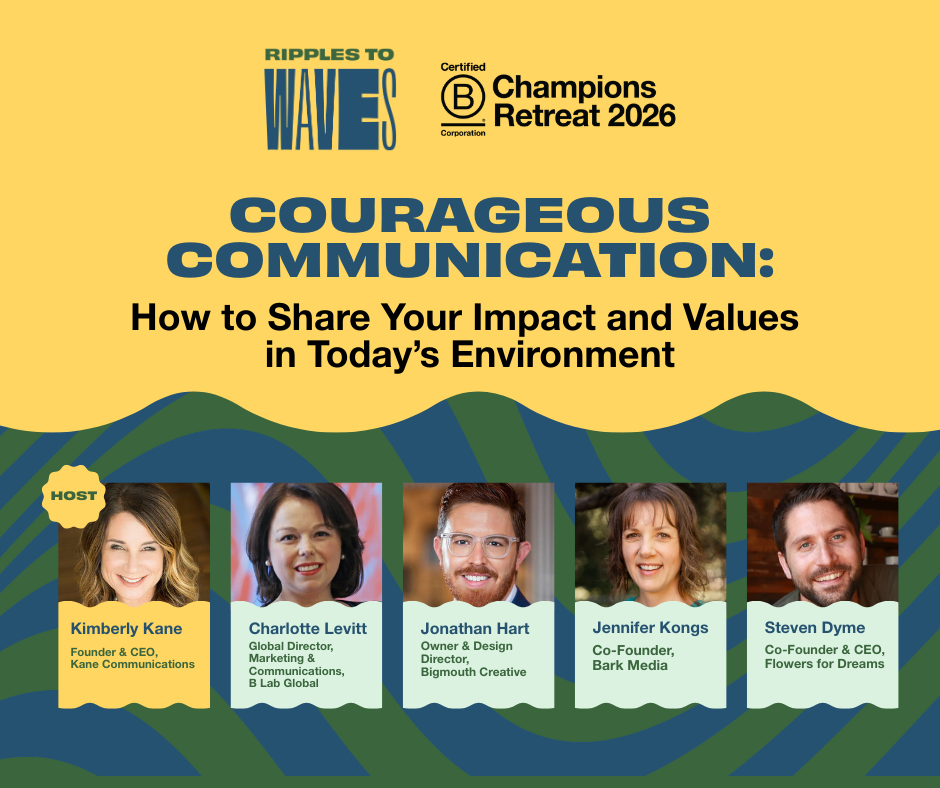
At the 2026 B Corp Champions Retreat, Bark Media Co-Founder Jennifer Kongs joined leaders from B Lab, Bigmouth Creative, and Flowers for Dreams for a panel discussion titled “Courageous Communication: How to Share Your Impact and Values in Today’s Environment.” The conversation explored how businesses can communicate values and impact clearly and credibly during this increasingly complex time period for purpose-driven brands.
A central theme throughout the panel discussion was the growing pressure many organizations feel to pull back from public conversations around impact and values. As panelists noted, terms like sustainability, inclusion, and justice have become increasingly politicized, leading some companies to be quieter about their work.
The panel pushed against that instinct. Silence, they argued, does not protect a company’s reputation. In many cases, it simply leaves space for someone else to shape the narrative.
Steven Dyme of Flowers for Dreams spoke about the role businesses can play in broader cultural and community conversations, particularly during moments of social and political tension. Drawing from his company’s public advocacy work around immigration issues in Chicago, Dyme emphasized that values-driven communications are not just about brand positioning, but about participating visibly and consistently in causes a company genuinely believes in. “If not us, then who?” Dyme said during the conversation.
Charlotte Levitt of B Lab framed the discussion through B Lab’s recent Greenshouting Guide, which encourages businesses to communicate sustainability efforts openly, accurately, and courageously. The guide was developed in response to “greenhushing,” or the tendency for companies to stay quiet about sustainability work out of fear of backlash or accusations of greenwashing.
“If you have a word for greenhushing and a word for greenwashing, but no word for what you should do, it’s pretty difficult to envision the future,” Levitt said.
For Bark Media, the conversation reflected a challenge we regularly help clients navigate: how to communicate complex, values-based work in ways that are specific, strategic, and human. Bark Co-Founder Jennifer Kongs emphasized that strong communications are not about trying to speak to everyone at once, but about understanding audiences clearly, telling stories that resonate with them, and helping build momentum around shared values and collective action.
“If you’re speaking to everyone, then you’re really speaking to no one,” Kongs said.
That kind of clarity is especially important for organizations working on technical or mission-driven issues. Whether communicating about sustainability practices, governance policies, or community impact, stories become more meaningful when they are grounded in real examples and connected to the people affected by the work. The panelists also emphasized that storytelling can help inspire broader participation by showing other organizations what meaningful action can look like.
The panel also emphasized that effective communications are built through consistency over time rather than reactive responses to individual comments or campaigns. Businesses should pay attention to trends, audience engagement, and trust-building over the long term instead of abandoning values-driven messaging after one negative reaction.
Jonathan Hart of Bigmouth Creative underscored the importance of grounding communications in authentic values rather than performative positioning. “The right message always follows the right values,” he said, noting that the strongest messaging grows from a company’s actual practices and commitments.
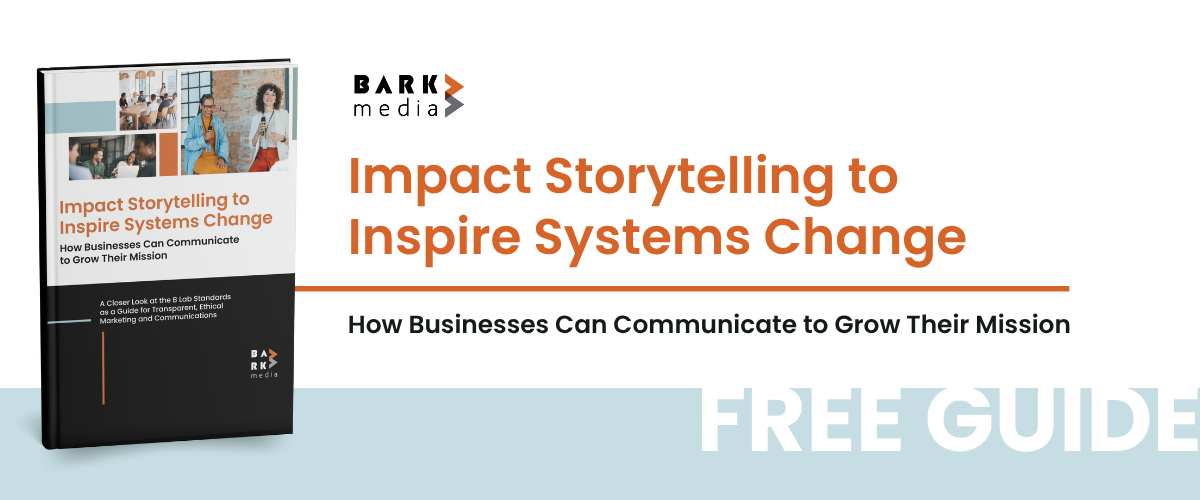
Kongs also discussed Bark Media’s recent work with B Lab on resources related to the updated B Corp Standards, including a free guide focused on ethical, values-driven communications. The resource explores how organizations can align storytelling and content strategy with the new standards while building trust, sustaining audience engagement, and communicating impact with greater clarity and authenticity. Rather than treating communications as separate from mission work, the guide positions storytelling itself as a form of advocacy and collective action.
Ultimately, the panel made the case that courageous communication is not about saying everything perfectly. It is about aligning words with action, communicating with humility, and continuing to participate in important conversations even when they feel difficult.
For purpose-driven businesses, that kind of communication is part of the work itself.