Farmers face many challenges—from shifting market demands and government requirements to unpredictable weather events like drought, flooding, and wildfire. Founded in 2024 and rooted in Ojai, California, Farmhand Foundation works alongside farmers on the practical, often unglamorous work that keeps farms viable: increasing administrative capacity, rebuilding healthy soil and ecosystems, navigating grants and compliance, telling farmer-led stories, and opening new markets.
The Farmhand Foundation was created by the founders of Tractor Beverage Company, a 10+ year-old organic drink company, to leave a legacy beyond the business. Tractor is rooted in the belief that soil is the foundation of life, and soul the foundation of living, reflecting the founders’ intent to help people fall in love with the soil again. Through 1% for the Planet, the foundation supports farmer success from soil to shelf by building capacity, caring for ecosystems, and expanding access to markets.
The Foundation has three key programmatic areas. The Farmers Prosper program works to ease labor stress, strengthen resilience, and foster community ties for farmers by offering practical, innovative, community-based support based on the needs of each farmer. This work includes regenerative organic transition, technical assistance, farmer-led storytelling, and writing grants; the team is also exploring leasing options and succession planning. The Thriving Ecosystems program builds the foundation for resilient agriculture through biodiversity monitoring, advancing farmer-led trials, restoring and building habitat, and strengthening soil health while sharing practical tools and knowledge. The Regenerative Business program builds financially durable ways for land care to generate true profit by opening markets and strengthening regional supply chains so stewardship and income reinforce one another.
Farmhand Foundation Co-Founder and Executive Director Whitney Clapper spent more than 10 years at Patagonia, where she led Brand Marketing and oversaw global community relationships and impact. She was inspired to co-found Farmhand Foundation by the desire to work more directly in her community and the chance to drive systemic impact on a local scale. In this Q&A, Whitney shares why the Foundation launched through a lens of listening and learning, what needs to change most urgently about the global food system, and what it means for Farmhand Foundation to work with the philosophy of “remembering forward.”
Farmhand Foundation is focused on supporting farmers in a variety of ways, from capacity assistance to market-building. Why do farmers need this kind of support? What challenges do they face and how do you help?
It seems like we’ve forgotten who feeds us and where our food comes from. We’ve forgotten the critical role farmers play—in sustaining each of us individually as part of nature, in sustaining our communities as stewards of the land, and in sustaining a critical component of our global economy.
Compared to major Midwest or Central California farmers, many of the farmers here in Ventura and Santa Barbara Counties are small- to mid-scale, and they navigate so many challenges. Land is ridiculously expensive here. There are labor shortages. ICE is decimating our communities. There’s water scarcity and other climate issues. At the same time, farmers are being asked to adapt to new regulations, navigate chaotic government funding challenges, and figure out how to let customers know that wind blemishes on their oranges don’t affect the taste of that mandarin, among many other aesthetic complaints customers may have. Resources are so limited that capacity is not a thing for farmers.
Many farmers here have grown up on multigenerational farms, but now their kids don’t want to farm, and they know they can sell the land for millions of dollars. There’s a world in which this rich agricultural community goes away within the next couple of generations if we don’t figure out a way for people to fall back in love with farming and soil again.
That’s the landscape we’re working within. Our most important priorities are that farmers work in harmony with one another, we keep local food in our communities, and we see agriculture continue in this region for the next seven generations. We lean into meeting farmers wherever they are, in order to do a little bit better collectively every single day.
That idea of meeting farmers where they are was fundamental to how you launched the organization. Can you share a bit about what that looked like?
We began with a listening tour of local farmers. We wanted to approach farmers with the goal of understanding what is happening in our agricultural communities. Our first question was, “Can I buy you a cup of coffee?” That set the tone. Farmers are used to people approaching them with expectations and judgment. We wanted to come at it with a lens of curiosity, to listen and learn.
The only requirement I asked of our team during these listening sessions was to leave your ego at home. We’ve got folks on our team who have also been farming for decades, and we’re all human, so it can be easy to bring our own ideas into these conversations. Our goal was to truly understand the community and its needs. We built our programmatic areas based on those conversations, not on what we think farmers might want to do or should do.
In what ways do you primarily serve farmers now?
We all have to be in this together if we’re going to change the broken food system. So whether it’s introducing a hedgerow to a farm to improve biodiversity, or a total regenerative organic transition, we’re here for it all. We are farmer-led and farmer-focused.
For us, this looks like a lot of different things. It’s practical resources and capacity-building through technical assistance and farmer-informed research and storytelling. It’s helping with soil fertility and growing practices. It’s improving soil health. It’s improving water efficiency.
Here is one recent example: Our local public school district called us because they’d received funding to buy local food, but they were having trouble connecting with local farmers. Well, during nine-to-five hours when the school staff is available, farmers are farming. We are equipped to be the go-between because we understand the farming world, and we understand the needs of partners and businesses. We can go meet farmers at 7:00 in the morning on the farm, and we can provide the capacity to talk to the school district during typical work hours.
We also have our own farm in Ojai called Moon + Oaks Farm. It’s an innovation space for farmers and the community to learn together. Because land is so ridiculously expensive, it’s beneficial to have a test space that doesn’t sacrifice profitable farm land. At Moon + Oaks Farm, we’re trialing soil fertility practices. We’re working with the local University of California agriculture extension programs to test various cover crops. We’re about to plant an olive grove, and we’ll test several varieties of olives. We currently have about 100 head of sheep and goats on our property to graze our cover crop, a regenerative practice that closes the nutrient loop, restores soil health through natural fertilization, and reduces machinery costs for mowing or tilling. We are also in partnership with other local shepherds and ocean farmers to trial wool pellets and a soil food made from sustainably harvested, locally processed, wild fish byproducts. These are all local resources that we have in our community. Part of shifting the food system is both exploring new methods and remembering time-honored traditions to care for our farmlands and greater watersheds.
A lot of our work is in providing support farmers need for things they want to do but don’t feel they have capacity for. For example, when farmers consider transitioning to organic, they often hear that it’s expensive, time-consuming, and they’ll lose sales. So we say, “we’ll help you find grants,” and “we’ll help with the paperwork,” and “we’ll find markets to ensure you don’t lose sales during the transition.”
Can you share more about your work to build the local market for farmers? How do you influence that?
There are many avenues to improvement, and we’re open to many types of conversations, because we don’t believe food has to only stay within the local community. But our focus right now is on the local markets because there’s so much opportunity. We’re working within the reality that Ventura County and Santa Barbara County make up the 11th-largest agricultural sector in the U.S., yet we export 90% of our food, and only 2% of businesses and retailers buy local. We see a huge opportunity in centering our communities and working to ensure more of our food stays local.
Right now, in this area, premium quality local food is in high-end restaurants and shops, and prepackaged food shipped from afar is in lower-income communities. We are trying to reframe that. People who aren’t wealthy are just as deserving of quality food as people who can regularly afford it. We are having a lot of conversations with local organizations like school districts and restaurants. For one example, we recently harvested and milled olive oil from one of our local farmers who is transitioning to organic. The primary focus for that olive oil is to go into our schools and local food hubs.
We are relocalizing, rooting into our local communities and farmers. It feels like a zag to the zig of growth in global markets. It’s rooted in what we’re trying to do as an organization and how we’re trying to show up for farmers. If we look to nature as our inspiration, there’s no model in nature where one huge system dominates the world. Everything starts with the smallest organisms, then forms into these interconnected ecosystems.
You mentioned that you’re also working to build bigger markets beyond the local markets. What’s the focus of that work?
We start with feeding the local community, then we move to national brands that are in our local community to enable them to buy from local farmers. We want to work with brands like Tractor to help them buy local, nutrient-dense, carbon-conscious food instead of imported lemons from another country.
We are also starting to work with national brands to build out what a more local supply chain might look like. In some cases, it’s a sustainability upgrade if a company just starts buying from West Coast farmers; in others, it’s an improvement if companies buy produce from the U.S. instead of shipping it in from overseas. This will all take much longer because so many national brands have established corporate supply chains, and they’re used to buying the cheapest product, which typically comes from overseas. So while we are having active conversations, it’s not a quick turn because we are working to rebuild entire systems.
The challenge is often cost, and that’s what we’re navigating with a lot of brands. They’ve sourced from overseas because it is less expensive, but it’s really not if you add up all of the resources and emissions it takes to get a lemon from Chile into the hands of someone in California, especially when we grow lemons here. How do we inspire and empower people to pay $12 for eggs that are fresh from chickens down the road, because they taste so much better and are more nutrient-dense and sustainable, when they can get eggs for $9 at the grocery store?
It requires shifting the narrative, as well as being patient with brands and supply chains, and maneuvering those conversations. The local markets are much more nimble and flexible.
To get much broader in the scale of our conversation, what do you think most urgently needs to change with our current global food system, and how is your work contributing to that change?
You sent this question ahead, and I put it into Google search because I was curious what it would say. I want to read what it came up with. It says, “The current reality of the global food system is that it is highly industrialized, consolidated, and by most measures, unsustainable…it functions as a major and often hidden driver in environmental degradation, climate change, and chronic disease…so while it provides an abundance of low-cost, calorie-dense food, it is failing to deliver adequate nutrition for billions, contributing to the double burden of malnutrition and simultaneous overnutrition, obesity and undernutrition.”
I mean, that’s really awful, and it demonstrates just how broken and unsustainable the food system is—and thus our need to evolve it. The challenge is that these systems have been in place for so long. Conventional agriculture began on the heels of World War 2, and the chemicals we used in the war are the same chemicals many still spray on our farms today. The good news is that it gives us so much opportunity for improvement.
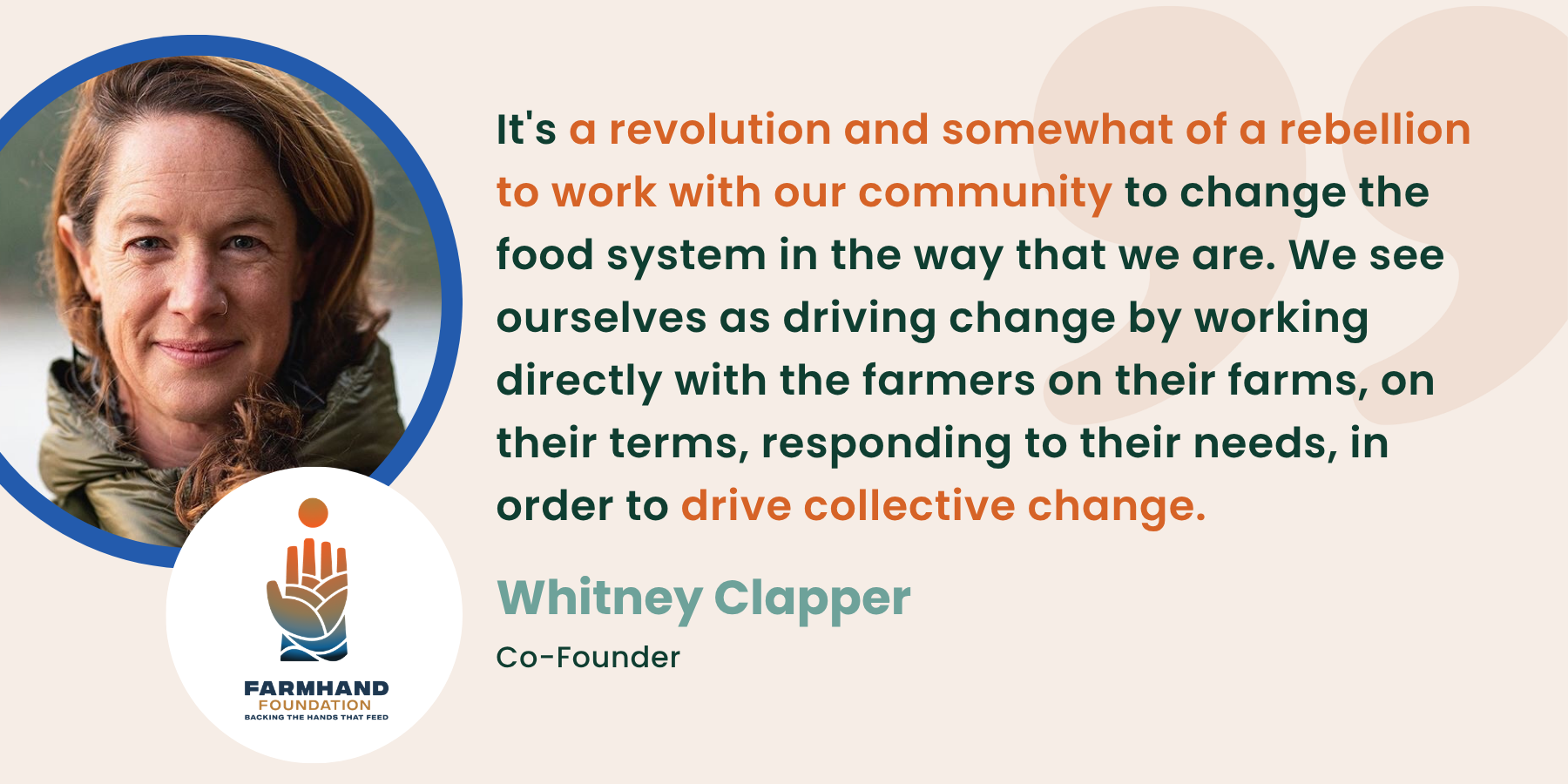
That’s why there’s a place for Farmhand Foundation. That’s why our goal is to work in harmony and unity. It’s a revolution and somewhat of a rebellion to work with our community to change the food system in the way that we are. We see ourselves as driving change by working directly with the farmers on their farms, on their terms, responding to their needs, in order to drive collective change. Our work is truly building this more resilient kind of regenerative, long-term approach to a regional agricultural system that can then become a model for other communities to do the exact same thing.
While you are farmer-centric and service-oriented, there is also a broader philosophy you bring to the work. Can you share a bit about that?
We call it “remembering forward.” This is not a new idea. This is actually a return to agricultural practices that Indigenous people have used for generations and still practice today. It’s about working in harmony and community with our ecosystem at large, human and non-human, seeing that we are not separate from nature. These are not new concepts, but we’ve somehow forgotten them, just like we’ve forgotten about the hands that feed us.
If we humans didn’t see ourselves as separate from nature, I think we would care more. If we knew our farmers and how ridiculously resilient they are, I think we would make better food choices and show up differently as consumers. We are in the space of trying to help people remember forward what a just and resilient food system looks like, because it is the complete opposite of the definition I read earlier.
We are part of nature. The future can’t just be about technology and AI. It has to be about community. It has to be cultural. It has to be ecological. Farming is a relationship with land and water. To us, this resilient future of food is about seeing farmers as stewards of the land, the water, and the whole ecosystem.
A just and resilient food system is a necessity for our survival as a species. Food nourishes people, land, and community all at the same time when it’s created in harmony. For us, the future of food isn’t necessarily about producing more, but producing wisely. It’s about producing in harmony. That’s remembering forward—remembering our original agriculture practices, recognizing where traditional knowledge meets modern science, and rebuilding our food systems so they are centered around stewardship and the kind of community knowledge that existed long before the industrial agriculture system was built.