Although the food we eat is among the most intimate and essential parts of our daily lives, in today’s world, the system that produces the fuel we put into our bodies is “largely invisible to us,” says Clare Fox, Executive Director of Sustainable Agriculture and Food Systems Funders (SAFSF). “Where our food comes from, how it is produced, the people who grow, pick, clean, ship, and stock our food—we mostly don’t see the labor, energy, infrastructure, animals, and humans that make our daily meals possible.”
The result of this disconnect is food that is less nutritious, less sustainable, less equitably available, and less beneficial to our local communities—harming us all. For more than 20 years, SAFSF has worked to unite funders to invest in sustainable food and agriculture systems, harnessing the collective impact of diverse funders through guidance and collaboration. “We need to demonstrate how impact investment into the food system offers a tremendous multiplier effect,” Clare says. “It benefits the environment, climate resilience, social justice, and economic inclusion all at once, and we hope this leads to overall increased interest and better alignment across philanthropies.”
As a nonprofit network, SAFSF seeks to mobilize diverse capital partners to catalyze food systems change, dismantle entrenched power structures, and activate impact capital across the funding spectrum. In this Q&A, Clare shares the key challenges and opportunities SAFSF is working to address, the role funders can play in reforming food markets and policy, and her vision of the future of food.
How would you describe some of the key challenges and opportunities SAFSF is working to address right now?
Research shows we need billions of dollars to course-correct our food system toward a regenerative and just future. We need every capital tool at our disposal, from non-extractive lending for farmers to government programs to philanthropic grant capital that can catalyze the right kinds of investments for community-led solutions.
Our biggest challenge is around the need to increase the pot of impact capital available for a just, regenerative transition in our food system. Food touches our lives and social issues in countless ways—from health and nutrition, to the economy and job creation, to climate change and immigration. And yet, philanthropy tends to view food more narrowly.
One of our biggest opportunities is to help funders see all the ways the capital they deploy can have an impact. For example, capital can help shift local market economies by enabling communities to adopt values-based procurement in schools, hospitals, and senior meal programs. That kind of investment helps shift public dollars toward local and sustainable farms and producers. It’s leveraging policy to create new market opportunities for producers that are values-driven, local, and sustainable. And grant capital can be the catalyst.
What’s missing in people’s awareness about reforming food systems?
How do we as individuals and communities understand our place within the food system? A food system is an abstract concept, and it can be hard for people to identify with it. But we all eat food. It’s both sacred and mundane. It connects us to our ancestors, our culture, and the land. It’s nourishment and fuel. It’s literally what we need to live. It’s common to all of us.
Yet much of our food system is actually invisible to us. What were the conditions that created these things we put into our bodies and ingest, one of the most intimate acts that we do? Where our food comes from, how it is produced, the people who grow, pick, clean, ship, and stock our food—we mostly don’t see the labor, energy, infrastructure, animals, and humans that make our daily meals possible.
What role does storytelling play in your work and the broader work to reform the food and ag system?
Storytelling is a critical tool for making the invisible visible. It can help connect the dots in ways people can feel. I recently saw the film *Food 2050*, which examines every dimension of the food system. It was co-produced by the Rockefeller Foundation and narrated by Viola Davis. She spoke at the premiere about her experiences growing up hungry. Hearing about her reality underscores that each of us has a stake in changing our food system.
The more we bring out those personal points of connection—this is not some issue over there, this is our lived experience—the more people will engage in policy advocacy, in creating social enterprise, and in funding and investing. And with increased literacy about food as a system that fuels our lives, we can think holistically about solutions to challenges such as diet-related disease, hunger, the exploitation of farm workers, the degradation of natural resources, overexposure to pesticides, and climate disruption in supply chains. These things are all connected.
The good news is that solutions are abundant. They’re everywhere. We invest in what works, which is often based in ancient Indigenous technology and knowledge about how we work cooperatively with the earth and each other. Humans have been doing this for millennia, and Indigenous cultures worldwide have continued to protect this knowledge. Those of us in the position of allocating resources just need to support them.
Why do we need to transform the agricultural economy? How does federal policy around agriculture influence all of our food choices?
Current federal policy has driven immense precarity in agricultural markets, and many predict an imminent economic farm crisis like that of the 1980s. The reality is that we expect a lot from farmers—adopt climate-smart practices, build healthy soils, pay workers better—but have failed to provide financial tools to help them do this work.
The entire agricultural economy is propped up by incentives for the status quo and the increased consolidation and power of a few food and fossil fuel companies. The impact on all of us as consumers is limited choice and loss of control over the food value chain. We need to realize that we all have a stake in taking back control of local and regional food systems from global conglomerates whose drive for profit comes at the expense of every consumer, worker, animal, and the environment.
What role do funders play in driving this change?
Funders can play a vital role in supporting financial innovation for agriculture and food economies. It’s critical that we create a whole new suite of products for farmers and communities to access capital. The financial products available to U.S. producers through the USDA and traditional commercial lending are so incredibly risk-averse. We’re never going to get to a more sustainable and equitable food system with the status quo of financial systems. So how do we build partnerships among grantmakers, lenders, investors, philanthropy, and community leaders around common priorities that support community-led solutions?
This is an area where philanthropy has really only dipped its toes. It’s hard work to figure out how to create new financial products. It requires incredible innovation. One example of an organization doing really interesting work in this area is Food System 6. Essentially, they are working to leverage philanthropy to unlock capital and create more flexible financial and lending tools for farmers and producers.
How can funders interact with the rest of the ecosystem in the most effective and important ways?
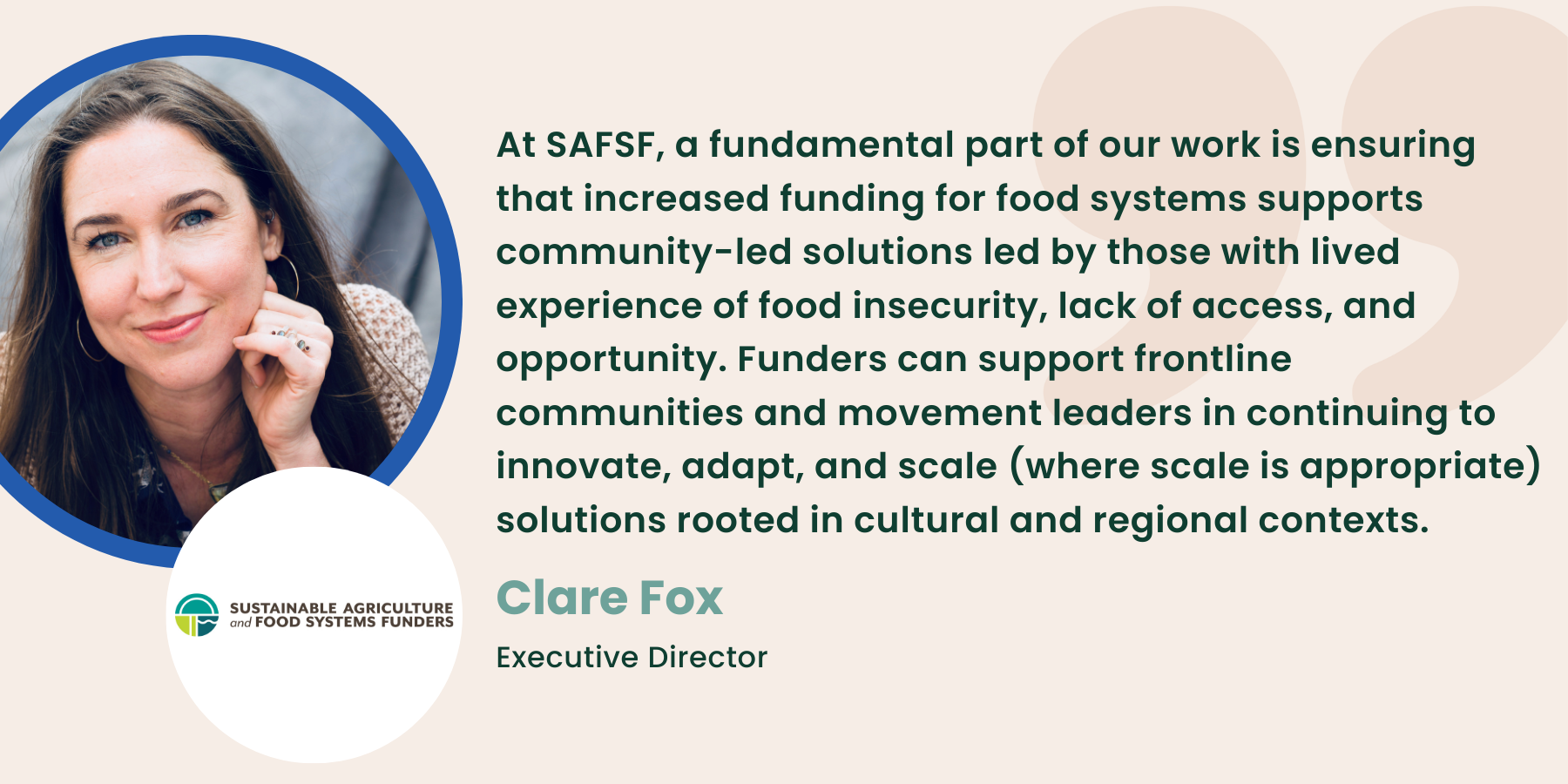
At SAFSF, a fundamental part of our work is ensuring that increased funding for food systems supports community-led solutions led by those with lived experience of food insecurity, lack of access, and opportunity. Funders can support frontline communities and movement leaders in continuing to innovate, adapt, and scale (where scale is appropriate) solutions rooted in cultural and regional contexts.
Food systems are bioregionally specific and land-based. There is no one-size-fits-all approach. Funders need to listen to what community partners say they need and give them maximum flexibility to lead with their lived experience and expertise. A critical trend in philanthropy is shifting decision-making power over capital into the hands of the most impacted communities, recognizing that they best understand what is needed on the ground. Just a few examples of this are Black Farmer Fund, Growing Justice Fund, and Equitable Food Oriented Development (EFOD).
What does the global food and ag system look like in your ideal future?
I love that food teaches us about cooperation, reciprocity, and what works and what doesn’t on planet Earth. I see a vision of a network of networks that’s coordinated yet primarily rooted in place, because agriculture and food production are about land- and water-based stewardship. We need to balance bioregional realities and constraints while also taking advantage of the opportunities for trade, exchange, and transportation offered by our globalized economy. Global supply chains contribute to greenhouse gas emissions and accelerate climate change, so the shorter they are, the better. On the other hand, we are not going to suddenly live in a world where we’re not connected globally. So how do we take the best of a globalized world into the future while minimizing the harmful impact of global commerce? I think we do that by shifting the scales more toward localization and regionalization.
I see a future of food that is just, regenerative, and democratic. Imagine cities, counties, and states across the country adopting values-based food policies that funnel hundreds of millions of dollars into local, sustainable farms. This would provide sustainable livelihoods to local and BIPOC producers and, in turn, fuel the growth of regional food hubs that better connect communities with food supply and expand access to fresh, nutrient-rich foods. Each element of that vision includes shifts in cultural priorities, policy developments, market opportunities, and new regional infrastructure that better connect, coordinate, and nourish communities. That is how we get to that future.